

Air-to-air heat pump’s electricity use is on the mind of almost everyone thinking about buying one. The question is often put simply: how much electricity will it use?
That’s a fair question. But a single consumption figure rarely tells the whole story.
What matters more is understanding what the electricity achieves and how much the air-to-air heat pump can reduce other heating. That’s why at Freida we look at a heat pump’s electricity use as part of the complete picture, not as a lone number.
You don’t need to know efficiency ratios or technical jargon to see where the savings come from. In this article we explain it clearly, with practical examples.
Air-to-air heat pump electricity use – why the number alone doesn’t tell the whole story
An air-to-air heat pump doesn’t work like ordinary electric heating. It doesn’t create heat directly from electricity – it brings warmth from the outside into your home.
For that reason, the electricity a unit uses is only part of the picture. One kilowatt-hour of electricity can deliver several kilowatt-hours of heat, which makes an air-to-air heat pump a very energy‑efficient choice.
The goal isn’t to use the least possible electricity. It’s to produce as much warmth as possible with as little electricity as needed.
That’s why raw consumption figures can be misleading. What matters is the whole picture: how much energy the unit uses and how much it replaces other heating.
Example: a heat pump’s electricity use and real-world savings
Imagine a single-family home that uses about 20,000 kWh of electricity a year for heating.
With a heat pump in place, total use can fall by about 25% – roughly 5,000 kWh a year.
That’s energy the heat pump can now use more efficiently from the outdoor air.
For many homes, the benefit isn’t just lower energy use but steadier warmth and better comfort all year.
Over time, those savings can add up to tens of thousands of kilowatt-hours.
What affects an air-to-air heat pump’s electricity use
An air-to-air heat pump’s electricity use isn’t fixed – it’s influenced by many aspects of your home and how you live.
The same unit can use very different amounts in different homes, depending on how much heat is needed and how evenly warmth spreads through the building.
Key factors include:
- outdoor temperature and season
- home size and layout
- insulation and building age
- set indoor temperature
- the unit’s model and condition
For that reason, we can’t give an exact consumption figure without details about your home.

How much electricity a heat pump uses for cooling
Summer use often brings questions about electricity. Many are surprised by how little cooling actually uses.
In practice, cooling is usually quite affordable. The temperature gap between inside and outside is small in summer, so the unit doesn’t need to work hard.
Because of that, cooling often costs only a few kronor a day, even though it can make home life noticeably more comfortable.
When your home stays calmly cool on hot days, life feels easier both day and night.

Winter electricity use of an air-to-air heat pump
In winter an air-to-air heat pump uses more electricity because it moves heat from a much colder outside into a warm home.
At the same time it also delivers more benefit. The heat pump replaces other heating and helps keep your energy costs down.
This is why winter use matters most. It’s when the pump begins to pay for itself.
A unit designed for Nordic conditions still produces heat efficiently in freezing weather, so savings are greatest then.
How your choice of unit affects your air-to-air heat pump’s energy use
Not all air-to-air units are equally efficient. The difference shows in how much heat a unit delivers for each unit of electricity it uses.
SCOP shows seasonal efficiency. A higher SCOP means more warmth from the same electricity.
A unit’s suitability for Nordic conditions also has a big impact on how well it performs in winter.
So choosing the right unit often matters as much as the device itself.
Freida has two decades of experience with Nordic conditions and 130,000 installed air-to-air heat pumps. We tailor every solution to your home, needs, and wishes.
Too many options? Find your heat pump in a minute.
How daily use and care shape an air-to-air heat pump’s energy use
An air-to-air heat pump’s real energy use depends largely on how it’s used day to day.
Keeping a steady temperature is usually more efficient than constantly switching the heat pump on and off. When it maintains an even level, it runs more efficiently – and frequent start–stops only add unnecessary strain.
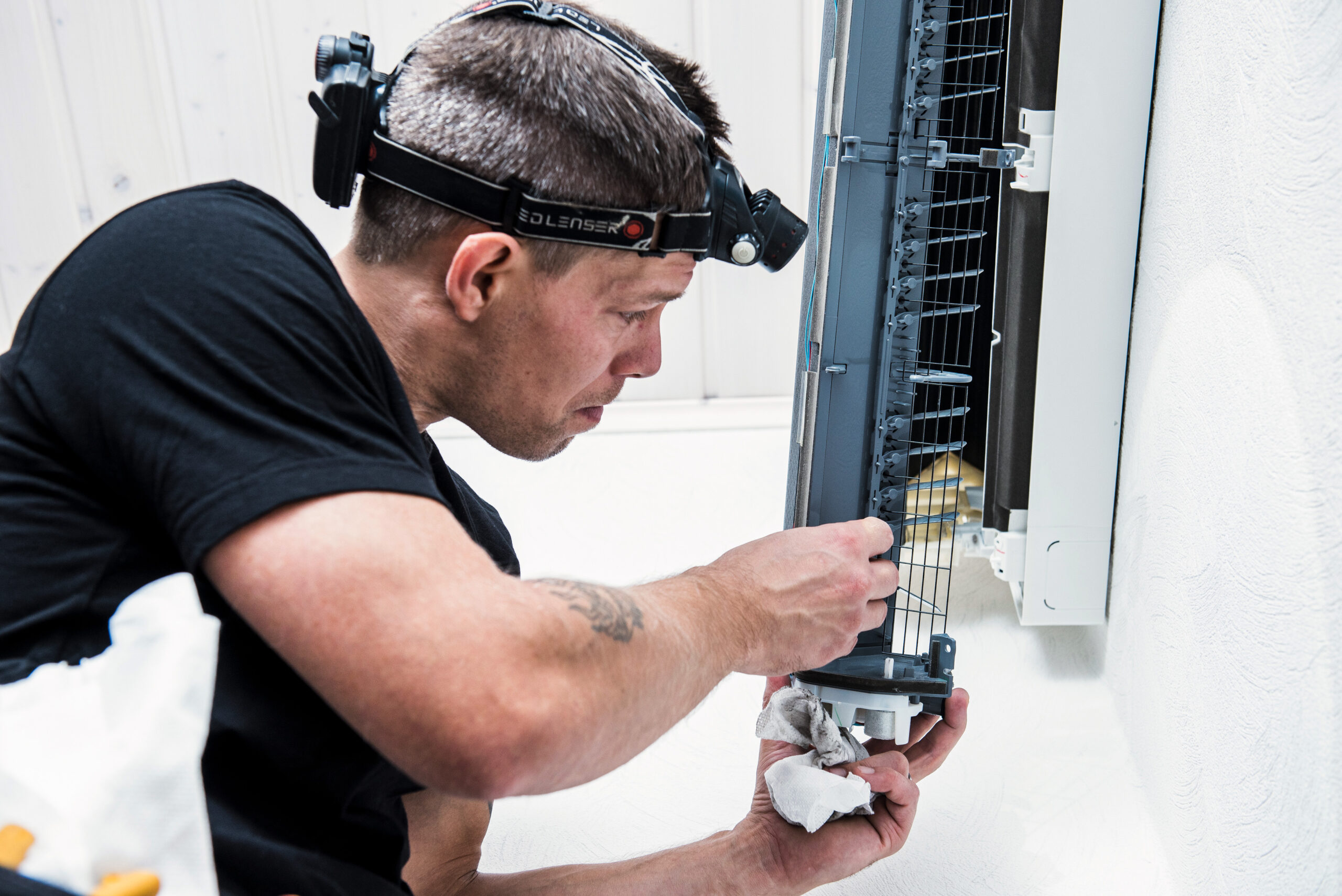
Regular maintenance also directly affects energy use and performance.
Over time an air-to-air heat pump collects dust. Regular filter cleaning – plus a professional service every 2–3 years – can boost efficiency by as much as 20–30%.
Freida Care
Whether your heat pump needs scheduled maintenance, fault repair or warranty service, Freida handles it with care, expertise and attention to detail.
Summary
An air-to-air heat pump uses relatively little electricity compared with the comfort and savings it provides.
What matters isn’t a single consumption number, but the overall effect on your home’s energy use and heating costs.
When an air-to-air heat pump is chosen well, installed by professionals, and used correctly, it can significantly reduce energy use and make your home comfortably steady all year.
Frequently asked questions about air-to-air heat pump electricity use
Many households see around 20–30% savings on heating costs. The exact amount depends on your home, existing heating system, electricity prices, and the set indoor temperature.
It does not.
Cooling is usually quite economical, since the unit doesn’t have to work hard when the temperature difference is small.
Generally, cooling costs around 5–15 kronor a day, depending on the size of the unit and the outdoor temperature.
During winter, an air-to-air heat pump works harder, but it also replaces more of your other heating. As a result, it can still significantly reduce heating costs.
Most savings are achieved during autumn, winter and spring, when temperatures are around freezing. In these conditions, the heat pump operates very efficiently and can significantly reduce the need for other heating.
Yes. If left unserviced, the unit will use more power and run less effectively. Regular cleaning and service keep consumption down and the unit in good condition.
We recommend servicing your air-to-air heat pump every 2–3 years.
Generally no. An air-to-air heat pump is most efficient when left running continuously. Frequent switching can increase energy use and put unnecessary strain on the unit.
No. Modern air-to-air heat pumps have control systems that protect the unit from damage – even in extreme conditions.

Find your heat pump
You don’t need to know anything about heat pumps.
Tell us about your home, your needs, and your wishes – we’ll take care of the rest.
Try it now – get a recommendation and a price in under a minute.